

.svg)
Grade A, Grade A+ and Grade B: A Practical Guide to Understanding and Verifying Commercial Property Grades in India
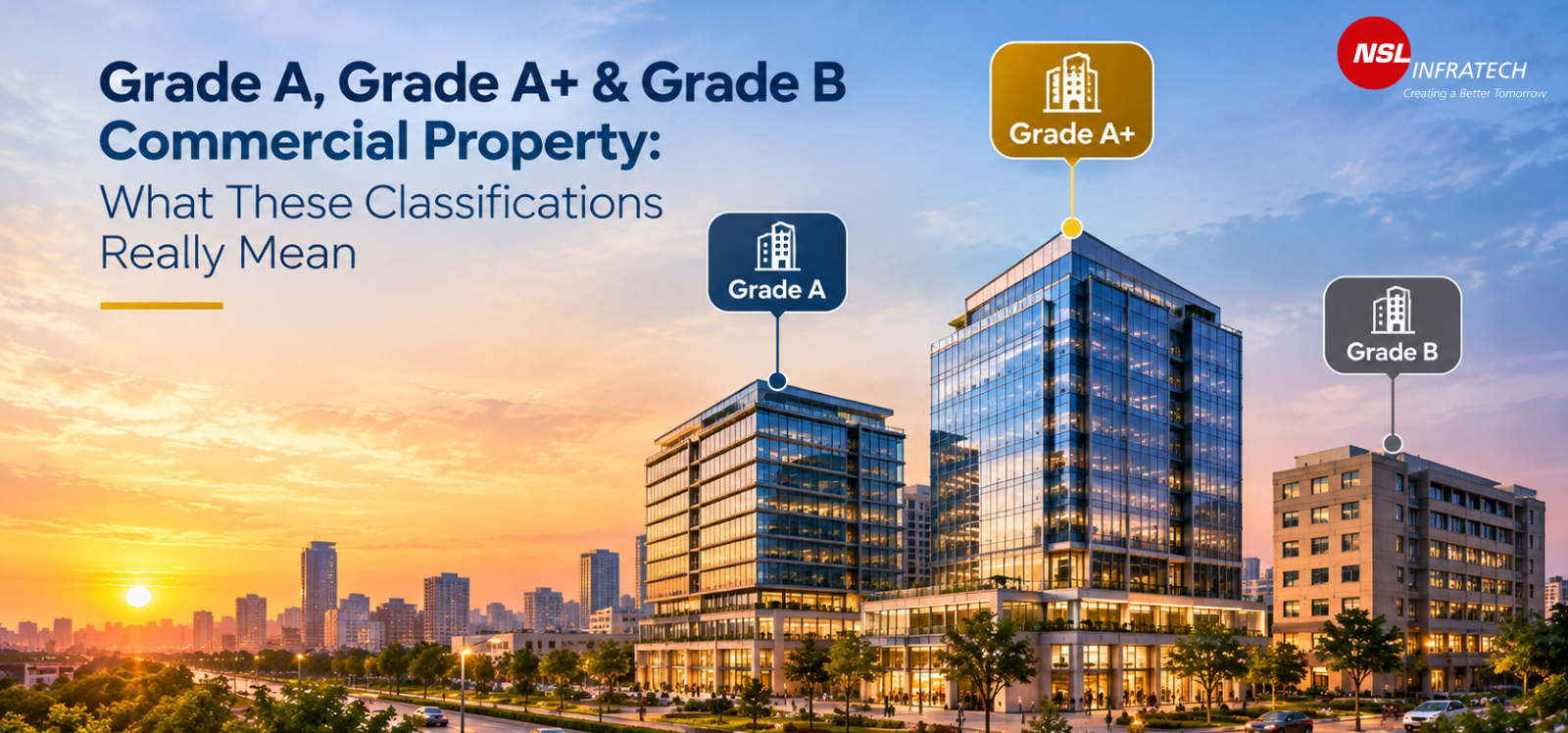
Search for office space or a warehouse anywhere in India and the word Grade A appears within the first few listings. So does Grade A+. Occasionally Grade B, usually attached to a lower rent. Almost nobody asks the obvious question: who decided this building is Grade A, and against what standard.
India does not have a single statutory, national certification system that assigns commercial buildings a Grade A, Grade A+ or Grade B classification. Instead, these terms are widely used as market conventions, with definitions and thresholds that vary across research firms, developers, brokers, cities and micro-markets. Grades are typically applied through market research and industry practice rather than through a government certification process.
This does not make the classification useless. It means the classification is descriptive, not regulatory, and the responsibility for checking whether a building actually earns its grade sits with the tenant or investor, not with the label on the listing.
This guide explains what Grade A office space generally indicates, how it compares with Grade A+ and Grade B, why the same label can mean different things in different cities, and how to verify a building’s grade before you lease or invest.
Where the Terms Actually Come From
The terminology evolved as a practical shorthand for comparing commercial buildings across markets. Research firms use it to track supply, demand and rents by quality segment. Brokers use it to shortlist options. Investors use it to benchmark assets and rental expectations. And for occupiers, it saves time: a large occupier evaluating fifty available properties can filter quickly for construction quality, management standard and location before spending time on site visits.
In India, firms such as CBRE, JLL, Knight Frank and others use grading in their market reports, generally built around a mix of construction specification, floor plate efficiency, building management, compliance documentation and tenant profile. The classification clearly exists and is tracked at scale. Knight Frank Research, for example, estimates that Grade A buildings make up about 54% of office stock across eight major Indian cities, Grade B about 42% and Grade C about 4% (Source: Knight Frank Research, “Commercial Real Estate: Potential is Built, Opportunity is Now”, 2025). JLL tracks Grade A and Grade A+ office space separately and reports different rents for each (Source: JLL, “Premiumisation is redefining office spaces in Delhi NCR”, July 2026).
What is not universal is the methodology. The internal thresholds used by different firms are not identical to each other, and the same building can be benchmarked differently depending on who is assessing it and against which peer set. Even headline figures differ. For the first half of 2026, JLL reported 5.38 million sq ft of gross office leasing in Hyderabad (Source: JLL, July 2026), while ANAROCK reported 6.4 million sq ft of Grade A gross leasing in the city for the same period (Source: ANAROCK Research, July 2026). The gap reflects differences in how each firm tracks and classifies the market. A property can also be described as Grade A in its marketing without a research firm having assessed it.
So when a listing says Grade A, it can mean any of three things. It has been independently assessed against a recognised methodology. It genuinely meets most of the commonly accepted criteria even without formal assessment. Or it may simply reflect the terminology used in a property’s marketing material, without a clearly stated assessment methodology. All three show up in the market side by side, and it is not always possible to tell them apart from the listing alone.
What Grade A Office Space Generally Signals
Despite the lack of a single rulebook, there is enough consistency across how the term gets used that a rough profile holds. A building commonly described as Grade A tends to combine several of the following: professionally managed common areas with a single accountable facility team, adequate power backup for lifts and common services, functioning fire safety systems with valid clearances, efficient floor plates that support modern seating layouts, reasonable connectivity to arterial roads and public transport, and a tenant base that includes at least a few established corporate or institutional names.
None of these individually proves a building deserves the label. Together, and backed by paperwork, they generally distinguish a Grade A property from an older or more basic one. The keyword is generally. A building missing one or two of these points is not automatically disqualified, which is also why the term is applied with some variation across the market.
What Grade A+ Usually Adds
Grade A+ is an even less standardised term than Grade A, largely used by developers and brokers to describe the upper end of the Grade A category rather than a distinct tier with its own separately agreed criteria. It is also not universally understood as simply “Grade A plus better specifications”. In practice, buildings marketed as Grade A+ typically push further on a small number of specific points: newer construction with larger, column free floor plates, a recognised green building certification such as LEED or IGBC rather than a claimed or pending one, higher lift speed and passenger capacity relative to occupant density, and full building power backup rather than backup limited only to common areas.
In some institutional market frameworks, premium or “relevant grade” classifications go beyond physical specifications to consider factors such as asset age, ownership, upkeep, tenant quality, rental performance and sustainability. JLL, for instance, has used the term “relevant grade” in its India office research for projects it considers premium quality on this broader assessment. In its analysis of Delhi NCR, JLL describes Grade A+ buildings as those with green certifications, advanced technology and premium amenities, usually newer or recently upgraded, and reports that occupiers paid about 32% more for Grade A+ space than for Grade A space in Q1 2026 (INR 123.5 versus INR 93.8 per sq ft) (Source: JLL, “Premiumisation is redefining office spaces in Delhi NCR”, July 2026).
Because the term carries no independent verification requirement, it is worth treating Grade A+ as a marketing signal that should be checked point by point rather than accepted as an automatic upgrade over Grade A. A building can genuinely deliver on all of these points and be worth the premium. Another may carry the same label while meeting only some of them, which is why documentation matters more than the descriptor.
What Grade B Actually Means
Grade B is not a synonym for poor quality. It usually describes a functional, often older building that has not been upgraded to current specification, or a newer building in a location that has not yet developed the surrounding infrastructure a Grade A tenant typically expects. Grade B space commonly comes with a meaningfully lower rent, smaller floor plates, partial rather than full power backup, and fewer shared amenities.
For many smaller businesses, regional offices and back office operations, Grade B is not a compromise. It is simply the appropriate specification for the requirement, at a cost that matches the use case. Treating Grade B as inferior in every situation misreads what the label is actually describing.
Grade B is also a large and active part of India’s office market. Knight Frank Research estimates that it makes up about 42% of office stock across eight major cities, the largest share in NCR (53%) and in the Mumbai Metropolitan Region (49%) (Source: Knight Frank Research, 2025). Businesses that are often well served by Grade B space include:
- Startups and early-stage companies that want to preserve capital while the team grows
- Small and mid-sized professional firms, such as accounting, legal, consulting and design practices, where client meetings matter more than campus amenities
- Branch, regional and sales offices that need a presence in a specific micro-market
- Back office, operations and support teams whose requirement is functional, reliable space rather than a premium address
- Training centres and smaller service businesses that need affordable, accessible floor space
- Companies that need interim or swing space during a relocation, fit-out or expansion
For these occupiers, the questions that matter are the same as for any building: valid approvals, fire safety, dependable power, reasonable maintenance charges and good access for employees and visitors. A well-maintained Grade B building that meets those basics can be a sound, cost-efficient choice.
A Practical Comparison
| Factor | Grade A+ | Grade A | Grade B |
|---|---|---|---|
| Typical construction age | New or recently completed | Established, generally well maintained | Often older, sometimes retrofitted |
| Floor plate design | Large, efficient, often column free | Standard, reasonably efficient | Smaller, less flexible layouts |
| Power backup | Full building backup | Common areas covered, often full backup too | Partial or limited backup |
| Certification | Recognised green certification common | Certification present but not universal | Rarely certified |
| Fire and safety compliance | Fully current, actively maintained | Generally current, should still be verified | Should always be verified directly |
| Typical tenant mix | Large corporates, MNCs, institutional occupiers | Mixed corporate, IT and ITES, regional businesses | Smaller firms, startups, regional operations, professional firms, branch and back offices |
| Rent positioning | Premium within the local market | Mid to upper market | Lower, cost efficient positioning |
Treat this as a general pattern seen across markets, not a fixed formula. Two buildings marketed with the same grade in the same city can still differ once specific documentation is compared side by side.
Does Grade A Mean the Same Thing Across Indian Cities?
Not necessarily. Commercial building grades are influenced by the age of the market, the development cycle, location, occupier profile and the building stock available in each city. A building described as Grade A is usually being compared with other buildings in its own market, so the benchmark itself shifts from city to city. The difference in stock composition across major cities is significant:
| City | Grade A share of office stock | Grade B share | Grade C share |
|---|---|---|---|
| Hyderabad | 69% | 29% | 2% |
| Bengaluru | 69% | 26% | 5% |
| Chennai | 66% | 31% | 3% |
| Kolkata | 55% | 34% | 11% |
| Pune | 52% | 47% | 1% |
| NCR | 45% | 53% | 2% |
| Mumbai Metropolitan Region (MMR) | 41% | 49% | 10% |
| Ahmedabad | 17% | 77% | 6% |
| Eight-city total | 54% | 42% | 4% |
Source: Knight Frank Research, “Commercial Real Estate: Potential is Built, Opportunity is Now” (2025), “Distribution of Grade A, Grade B and Grade C Office Stock”.
Part of the explanation lies in when and how each market was built. A large share of office supply in Hyderabad, Bengaluru and Chennai has come up during the technology-led expansion of the last two decades, much of it in planned business districts and technology parks. MMR and NCR also carry a substantial base of older office stock in long-established business districts, alongside newer Grade A developments.
The practical takeaway: a Grade A building in a market where Grade A is the norm is being compared against a different peer set from a Grade A building in a market where it is scarcer. Grade labels are most useful when read against the local market, and ideally the specific micro-market, rather than as a national standard.
What Does Grade A Mean in Hyderabad?
Hyderabad is one of India’s most Grade A-heavy office markets. Knight Frank Research estimates that Grade A buildings make up about 69% of the city’s office stock, level with Bengaluru for the highest share among major cities (Source: Knight Frank Research, 2025). Demand has stayed strong. JLL reported India’s gross office leasing at 37.9 million sq ft in H1 2026, with Hyderabad contributing 5.38 million sq ft, up 17.6% year on year (Source: JLL, July 2026). Global Capability Centres (GCCs) are a major driver, accounting for 48% of the city’s Grade A office leasing in H1 2026 (Source: ANAROCK Research, July 2026).
Because so much of Hyderabad’s office stock already carries the Grade A description, the label alone does little to separate one building from another. GCCs and institutional occupiers in the city typically look past it to specifics. They look at connectivity to arterial roads and the metro, and how easily employees can commute across shifts. They look for floor plates large and efficient enough for consolidated teams and future expansion, and for enough parking for employees and visitors. They expect reliable power with full backup for business continuity, and recognised green certification and energy performance that support their own sustainability commitments. They value amenities such as food courts, wellness and collaboration spaces that make the office a place people want to come to. And they expect professional building management, with clear accountability for maintenance, security and compliance. In Hyderabad, a building earns its grade by how well it delivers on these points, day after day.
Why This Matters More Than It Seems
Asset quality and grade can influence rental positioning, investor perception and exit attractiveness, while financing decisions typically depend on a broader assessment of the asset, cash flows, documentation and risk. A tenant who accepts a Grade A label at face value may end up paying a Grade A+ rent for a Grade A building, or paying for specifications that the documentation does not fully support. Equally, an occupier who looks only at labels may overlook a well-run building with a more modest description that fits the requirement better. Checking the details before signing gives both sides a clearer, fairer basis for the lease discussion.
This is also why a consistent, documentation-led approach to grading benefits the whole market. Occupiers can compare buildings with confidence, and developers who invest in quality can demonstrate it rather than simply describe it.
The Eleven Point Checklist Worth Saving
Because the grading itself cannot be relied on alone, this is the part that actually protects a tenant or investor. Save or screenshot it before your next site visit.
- Ask for the occupancy certificate and confirm it matches the current use of the building.
- Ask for current fire safety clearance, not a certificate from the year of construction.
- Confirm the actual power backup capacity in kilovolt amperes, and whether it covers common areas only or the full leased space.
- Ask whether any green certification is confirmed and current, or only applied for.
- Request the current tenant list and the building’s vacancy level.
- Ask how the quoted area is measured (carpet, built-up, super built-up or chargeable/leasable area) and ask for the efficiency ratio: usable carpet area as a percentage of the area on which rent and maintenance are charged. These terms are not interchangeable and their calculation can vary by market and transaction, so confirm the definitions in writing.
- Confirm the lift count and passenger capacity relative to the number of occupants the building is designed to hold.
- Check who manages the building day to day, and whether there is a single accountable facility management team.
- Visit during a normal working hour, not a quiet weekend, to see actual traffic, parking pressure and lift wait times.
- Ask for the maintenance charge structure and what it does and does not cover.
- Confirm the developer’s track record on other completed projects, not only the marketing material for this one.
A quick note on area terms: carpet area is the net usable floor area of a unit, excluding external walls, service shafts, balconies and open terraces, and has a statutory definition under the Real Estate (Regulation and Development) Act, 2016. Built-up area adds elements such as wall thickness. Super built-up or chargeable area adds a proportionate share of common areas such as lobbies, corridors and services. How these are calculated can differ from one building and lease to another, which is why two buildings quoting the same area can offer quite different usable space.
A building that satisfies most of these points with documentation, rather than verbal assurance, is doing more to earn its grade than the label alone ever will.
Conclusion
Grade A, Grade A+ and Grade B are useful shorthand for a market that needs some way to compare hundreds of buildings quickly. They are market conventions rather than statutory certifications, and they mean the most when read against the local market and backed by documentation. The label is a starting filter. The eleven points above are what actually confirm whether a building lives up to it.
NSL Infra Tech’s view is simple: a building’s grade should be demonstrated, not just described, and the real measure of a commercial building is how well it serves the businesses and people who use it every day.
This guide is published by NSL Infra Tech as a reference for occupiers and investors evaluating commercial property in India.
Frequently Asked Questions
Is Grade A officially certified in India?
No single statutory national certification assigns Grade A, Grade A+ or Grade B to commercial buildings in India. The grades are market conventions used by research firms, developers, brokers and investors, and their definitions vary. Specific attributes can be independently certified or approved, such as green building ratings (LEED, IGBC or GRIHA), fire safety clearances and occupancy certificates, and these are what give a grade its substance.
What is the difference between Grade A and Grade A+ office space?
Grade A+ generally describes the upper end of Grade A: newer buildings with larger, efficient floor plates, confirmed green certification, full power backup and a stronger amenity and technology offering. Some institutional frameworks also weigh ownership, upkeep, tenant quality and rental performance. In Delhi NCR, JLL reported a rent premium of about 32% for Grade A+ over Grade A space in Q1 2026 (Source: JLL, July 2026).
Is Grade B commercial property a bad investment?
Not necessarily. Grade B describes a functional building with a more modest specification, often older or in a developing location, usually at a lower rent. It makes up about 42% of office stock across eight major Indian cities (Source: Knight Frank Research, 2025). Whether it suits an investor depends on location, tenant demand, condition, documentation and price rather than the label, and independent professional advice is worth taking before any investment decision.
Does Grade A mean higher rent?
Within the same micro-market, Grade A space usually commands a higher rent than Grade B because of its specification, management and amenities. Rent is also shaped by location, supply, vacancy and lease terms, so a Grade A building in one micro-market can rent for less than a Grade B building in a more central one.
Does Grade A guarantee better returns?
No. Grade can influence rental positioning, investor perception and exit attractiveness, but returns depend on purchase price, occupancy, tenant quality, lease structure, maintenance costs and market conditions. A label is not a guarantee of performance.
How can I verify whether a building is genuinely Grade A?
Ask for documents rather than relying on the listing: the occupancy certificate, current fire safety clearance, confirmed green certification, power backup capacity, area measurement and efficiency, the tenant list, vacancy and facility management details. The eleven-point checklist above covers each step. Where possible, compare the building with how research firms classify stock in that micro-market.
What documents should I check before leasing commercial space?
At a minimum: the occupancy certificate, a current fire NOC, title documents or proof of the lessor’s right to lease, approved building plans, green certification if one is claimed, an area statement showing how carpet and chargeable area are calculated, and the draft lease covering rent, escalation, maintenance charges, lock-in and exit terms. Have the documents reviewed by a legal professional before signing.
Does Grade A mean the same thing in Hyderabad, Bengaluru and Mumbai?
Not exactly. The label is broadly similar, but each market benchmarks against its own stock. Grade A makes up about 69% of office stock in Hyderabad and Bengaluru, compared with about 41% in the Mumbai Metropolitan Region (Source: Knight Frank Research, 2025), so a Grade A building is compared against a very different peer set in each city.
Sources
- Knight Frank Research, “Commercial Real Estate: Potential is Built, Opportunity is Now” (2025): https://content.knightfrank.com/research/3054/documents/en/cre-potential-is-built-opportunity-is-now-2025-12496.pdf
- JLL, “India office leasing dips 3.9% to 37.9M sf; GCCs strong” (14 July 2026): https://www.jll.com/en-in/newsroom/india-office-leasing-dips-3-point-9-percent-to-379m-sf-gccs-strong
- JLL, “Premiumisation is redefining office spaces in Delhi NCR” (13 July 2026): https://www.jll.com/en-in/insights/premiumisation-is-redefining-office-spaces-in-delhi-ncr
- ANAROCK Research, H1 2026 GCC office leasing analysis, as reported by IANS (17 July 2026): https://www.newkerala.com/news/a/gccs-account-45-pc-gross-office-leasing-india-396.htm





Leave a comment
Be the first to comment