

.svg)
Knowledge, Industry, and a Balanced Economy: How Uppal Is Redefining East Hyderabad
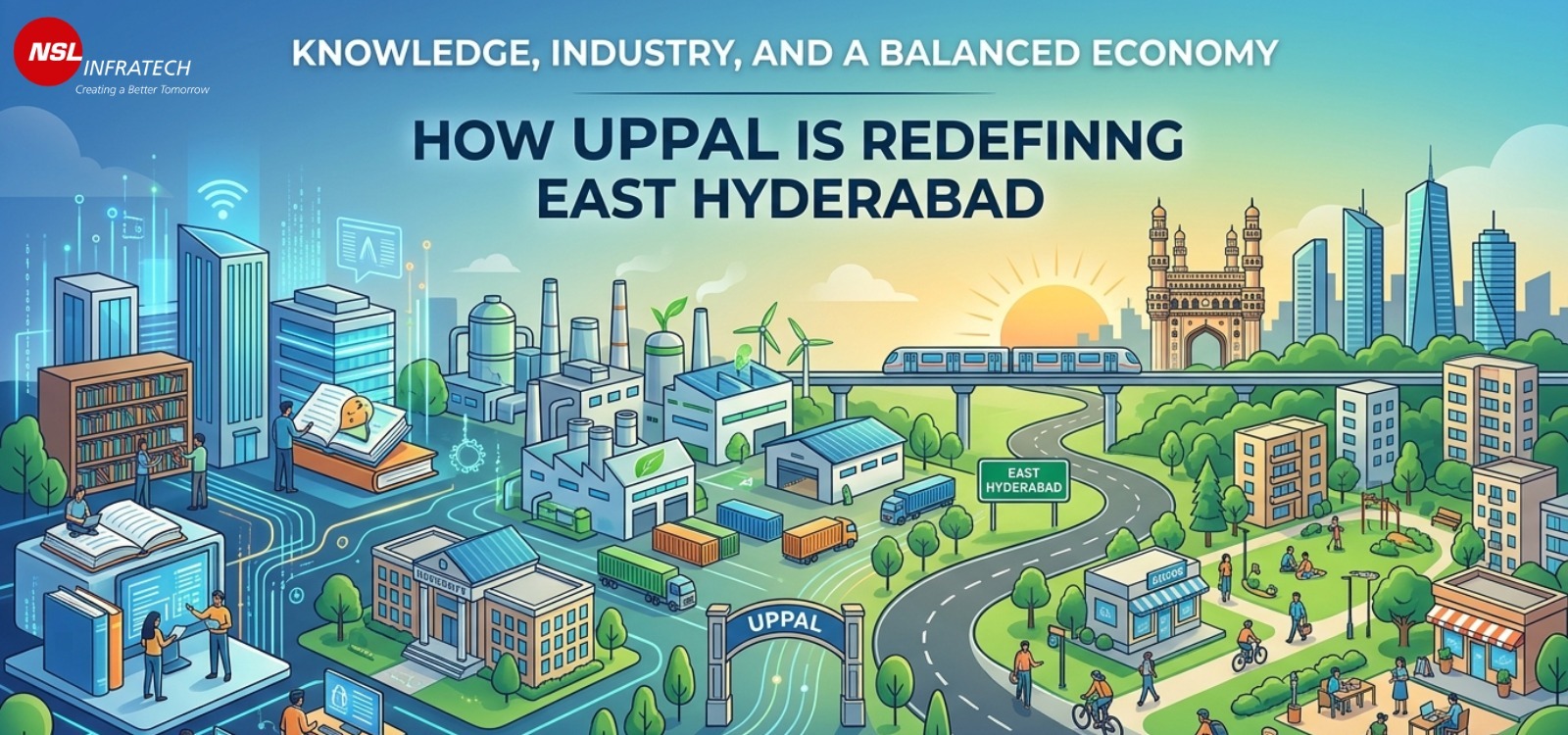
For decades, Uppal was defined by its smokestacks and industrial yards. It was the city’s manufacturing backbone — functional, essential, but rarely considered a destination for professionals or homebuyers. That perception is changing rapidly. Today, Uppal is at the centre of one of Hyderabad’s most ambitious economic transformations: a deliberate, policy-driven shift from a traditional industrial zone into a high-tech knowledge corridor.
This shift is not accidental. It is the result of state-level thinking, large-scale private investment, and a clear-eyed understanding of what Hyderabad needs to sustain its growth, which is a more balanced economy that does not concentrate all its prosperity in the west.
Here’s the revised article with all dashes removed and replaced with complete, flowing sentences:
The Policy Behind the Transformation: Understanding GRID
The foundation of Uppal’s transformation lies in a state initiative called the GRID Policy, which stands for Growth in Dispersion. The idea is straightforward. Hyderabad’s economic growth has historically been concentrated along its western corridor, from HITEC City to Gachibowli and the Financial District. While this made the city globally competitive, it also created imbalances in real estate prices, infrastructure load, and job accessibility.
The Telangana Growth in Dispersion (GRID) Policy (announced ~2020) aims to decentralize Hyderabad’s IT growth beyond the Western Corridor (Madhapur, Gachibowli) toward northern and eastern zones like Uppal, Pocharam, and Kompally, reducing congestion and promoting citywide development.
Key Features:
Dispersal Focus: Encourages IT/ITeS and BFSI growth in northern and southern zones to ease pressure on the Western CorridorIndustrial Conversion: Allows existing industrial parks in areas like Uppal, Nacharam, and Patancheru to be repurposed as IT parks.
Incentives: Special benefits for Anchor Units (500+ jobs in 3 years) and partial land conversion rights for developers.
Infrastructure: IT towers and parks being developed at Kompally, Kollur, and other emerging hubs.
Sunset Clause: Incentives available only for units initiated within 5 years of the policy announcement.
The GRID Policy addresses this by actively steering IT investment, infrastructure, and institutional development toward the east. Rather than letting market forces alone determine where growth happens, the government is shaping the geography of Hyderabad’s next phase of expansion. Uppal, with its existing connectivity, land availability, and proximity to the city’s core, is the natural anchor for this strategy.
For homebuyers and investors, policy-backed growth matters enormously. When a government commits to developing an area through zoning decisions, infrastructure investment, and incentives for private players, it reduces risk and adds long-term credibility to any real estate decision made in that zone.
IT and Knowledge Industry: Building a New Employment Hub
The most visible sign of Uppal’s transformation is the scale of knowledge-sector investment now taking shape in and around the area.
Genpact’s Expansion: A Landmark Commitment to East Hyderabad
Perhaps the single most significant indicator of Uppal’s rise as a knowledge hub is Genpact’s decision to massively expand its presence here. The company is developing Genext Square, a Grade-A commercial campus of approximately 2 million square feet, directly adjacent to its existing Uppal facility.
When complete, Genext Square is expected to add 15,000 seats, contributing meaningfully toward a broader goal of creating over 1 lakh IT jobs in the eastern corridor. This is not a speculative development. It is a firm commitment by one of the world’s largest professional services firms, and it signals the kind of confidence that attracts further investment.
What makes this particularly interesting from a residential standpoint is that Genext Square is not purely an office project. It incorporates nearly 9 lakh square feet of residential space, reflecting a deliberate effort to create a self-sustaining ecosystem where people can live within walking distance of where they work. This walk-to-work model reduces commute stress, improves quality of life, and consistently supports stronger residential demand in the surrounding neighbourhoods.
Genpact’s AI Gigafactory: Positioning Uppal on the Global Map
In a sign of just how seriously the area is being developed as a knowledge hub, Genpact has also announced the launch of its AI Gigafactory at Uppal. The initiative aims to build a global talent pool of 25,000 AI professionals, with Uppal designated as a primary hub for this programme.
This is not simply an incremental expansion of existing services. It represents a strategic decision to anchor cutting-edge, future-facing work in artificial intelligence, automation, and digital transformation squarely in East Hyderabad. The presence of an AI Gigafactory will attract talent, institutions, and auxiliary services, all of which have positive downstream effects on the residential market.
NSL Arena SEZ: An Established Anchor for Growth
Before the current wave of investment, the NSL Arena SEZ had already established Uppal’s credibility as a commercial destination. Spread across 36 acres, the integrated development currently offers 1.6 million square feet of operational IT SEZ space and hosts over 16 major companies.
Critically, the project has been designed with scalability in mind, with capacity to expand to 5 million square feet over time. NSL Arena is not just a building. It is a functioning ecosystem that already employs thousands of professionals and has demonstrated that premium commercial space in East Hyderabad is viable, in demand, and sustainable.
Government-Backed IT Park Conversions
The state government has also partnered with four to five private developers to convert former industrial sites into modern IT parks. This strategic repurposing of land is significant for two reasons. First, it expands the supply of quality commercial space in the east. Second, it signals a systematic, government-supported effort to diversify the economy of this corridor, moving it beyond its industrial origins into higher-value, knowledge-based employment.
Industrial Transformation: Evolution, Not Elimination
The story of Uppal’s economy is not simply a replacement of the old with the new. Industrial activity remains a genuine contributor to the local economy, but the nature of that activity is evolving.
The HILT Policy: Responsible Repurposing
The Hyderabad Industrial Lands Transformation (HILT) Policy 2025, introduced by the Telangana government, seeks to repurpose over 9,000 acres of underutilized industrial land within the Outer Ring Road (ORR) for residential, commercial, and recreational use. The policy aims to transform Hyderabad into a more livable city by relocating polluting industries outside the ORR, though it has faced criticism as a land-looting scheme.
Key Aspects:
Objective: Reorganize Hyderabad’s landscape by freeing up industrial land for better urban infrastructure, green spaces, and high-value real estate.
Eligibility: Primarily targets private landowners with clear titles; leasehold lands are excluded.
Voluntary: Land conversion is entirely opt-in.
Focus: Encourages owners of closed or underutilized industrial land to transition into developers or investors in commercial and residential sectors.
The Hyderabad Industrial Lands Transformation Policy, known as HILT, came into focus in early 2026 and provides a framework for repurposing aging industrial areas into sustainable, mixed-use zones. The policy addresses a challenge familiar to any growing city. Older industrial land, often located in what are now residential or semi-residential areas, can become sources of pollution, congestion, and land-use inefficiency.
Under the HILT framework, such areas are being systematically redeveloped. The goal is not simply to make space for offices or housing, but to create environments that blend commercial activity, residential living, and public amenity in a planned, responsible way. For existing residents, this means a reduction in pollution and industrial disruption. For new residents and investors, it means that the trajectory of these neighbourhoods is firmly upward.
The Uppal IDA: A Core Economic Engine With a Green Future
The Uppal Industrial Development Area, commonly referred to as the Uppal IDA, continues to function as an important part of the local economy, providing employment across manufacturing and related sectors. What is noteworthy is that the IDA is now the subject of enhanced greenery and environmental programmes, designed to bring it more in line with the residential and commercial character of the surrounding area.
This reflects a broader philosophy in how Uppal’s development is being managed. Rather than abandoning its industrial heritage, the area is being guided toward a version of industrial activity that coexists more gracefully with modern urban life.
Economic Balance: Why It Matters for Homebuyers
From a pure real estate perspective, the diversification of Uppal’s economy is a significant positive signal.
A residential area dependent on a single sector or employer is inherently more vulnerable. If one company downsizes or one industry contracts, the ripple effects on housing demand, rental income, and property values can be severe. By contrast, an area with employment spread across IT services, artificial intelligence and innovation, manufacturing, logistics, and research institutions is far more resilient.
Uppal is developing exactly this kind of layered economy. IT jobs from Genpact, NSL Arena, and the new IT parks create professional demand for quality housing. Industrial employment supports a broader population base. Research and academic institutions concentrated in the Uppal-Tarnaka-Habsiguda belt add an additional layer of stable, knowledge-sector employment. This economic diversity is a genuine long-term advantage for anyone considering a home purchase in the area.
Lifestyle and Social Infrastructure: The Finishing Touches
Economic growth alone does not make a place liveable. The question that professionals and families ask is not just where the jobs are, but whether they would enjoy living in the area.
Uppal’s development story includes a growing set of lifestyle and social infrastructure that increasingly answers that question in the affirmative.
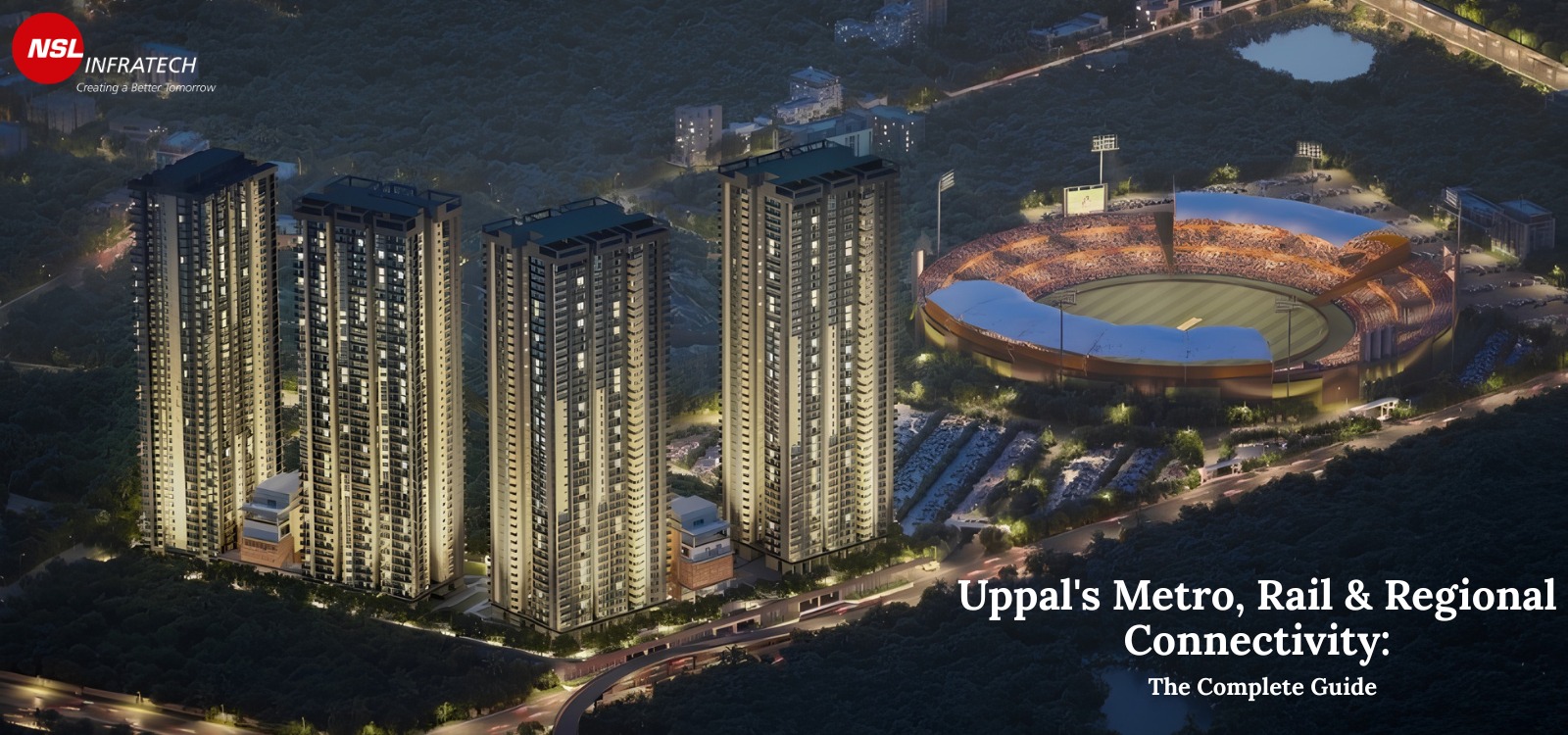
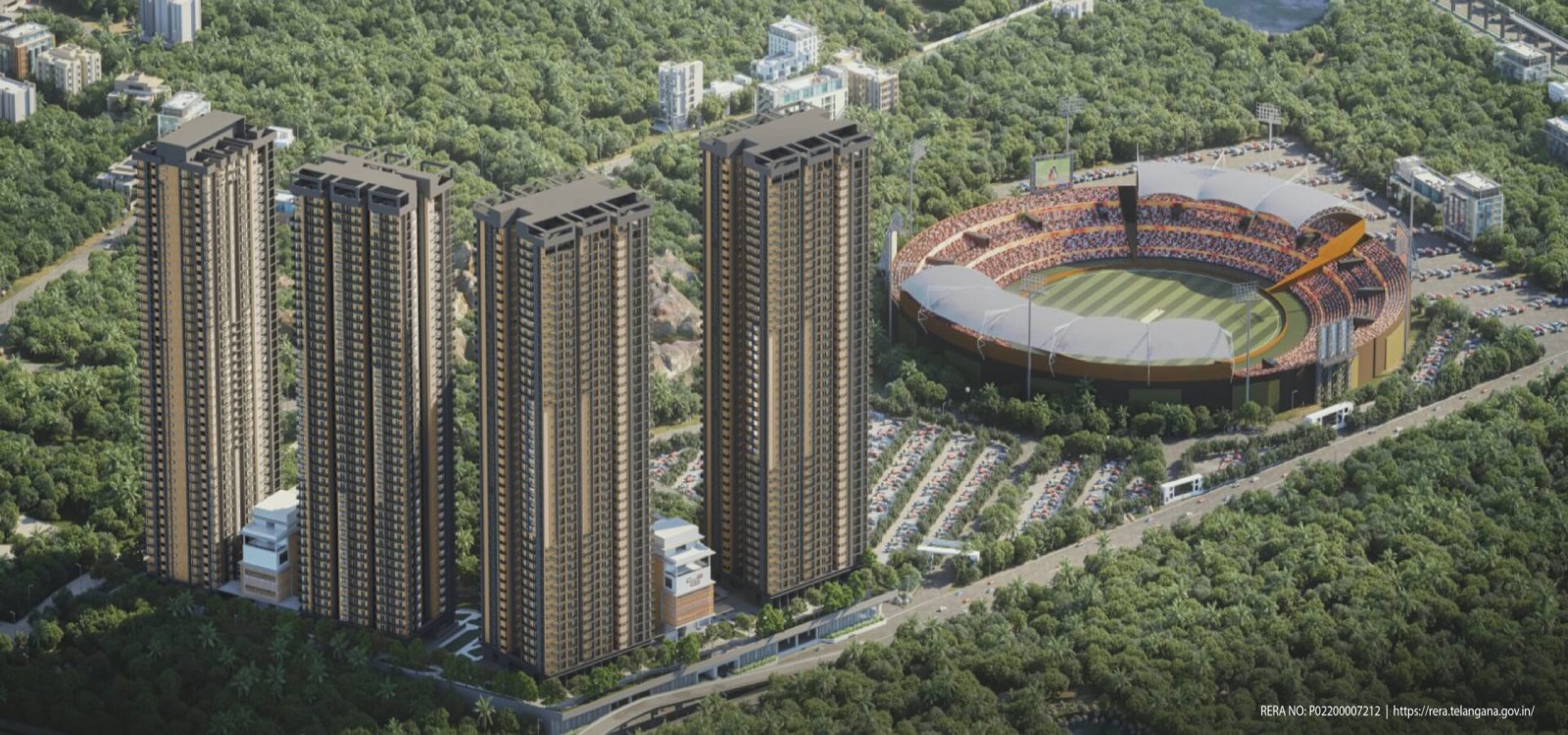
The Rajiv Gandhi International Cricket Stadium, one of the largest cricket venues in the country, is located in the vicinity and has already established the area’s identity as a destination for major events and public life. As the eastern corridor develops, the stadium is expected to be surrounded by retail, hospitality, and entertainment infrastructure that transforms match days into broader economic and social activity for the neighbourhood.
Upcoming retail malls and commercial developments are adding another dimension to the lifestyle proposition. The availability of quality retail, dining, and entertainment options within the locality reduces the dependency on cross-city travel for everyday needs. This is a factor that consistently improves quality of life and residential desirability.
These social infrastructure investments work in concert with the economic fundamentals. A well-paying job nearby, a comfortable home, and the ability to access quality retail, sport, and culture locally represent the combination that sustains long-term residential demand and protects property values over time.
The Long View: What This Means for Real Estate
Uppal’s transformation from industrial zone to knowledge hub is not something that happened overnight, and it will not complete overnight either. But the direction is clear, the investments are real, and the policy framework is firmly in place.
For homebuyers, the question is rarely whether to wait for full development, because by the time an area is fully developed, the most favourable window for purchase has usually passed. The value in areas like Uppal lies in recognising the trajectory early, understanding why the fundamentals are strong, and making decisions accordingly.
The combination of a supportive state policy, large-scale employer presence, industrial repurposing, and growing social infrastructure creates a demand profile that is both broad and durable. It is not dependent on any single sector doing well. It is not vulnerable to a single employer relocating. It is the kind of multi-layered, economy-backed residential market that delivers steady appreciation over the medium and long term.
Conclusion
The transformation of Uppal into a knowledge and innovation hub represents one of the more significant urban economic shifts currently underway in Hyderabad. Driven by the GRID Policy, anchored by large-scale investments from companies like Genpact, supported by the NSL Arena SEZ, and progressively reshaped by policies like HILT, the area is building the foundations of a balanced, resilient economy.
For those evaluating where in Hyderabad to invest in a home, understanding this economic context is as important as understanding the infrastructure or the price points. A home is not just a structure. It is a stake in the neighbourhood around it. And in Uppal, that neighbourhood is being built with serious intent, significant capital, and a long-term vision.
At NSL Infratech, we have been part of Uppal’s story for years. Our developments here are not speculative bets on an uncertain future. They are considered decisions rooted in a deep understanding of how this corridor is growing and why it is positioned for sustained, long-term value. If you are exploring your options in East Hyderabad, we invite you to learn more about our projects and the opportunity this transformation represents.

Leave a comment
Be the first to comment